Buysafe.es Property Platform
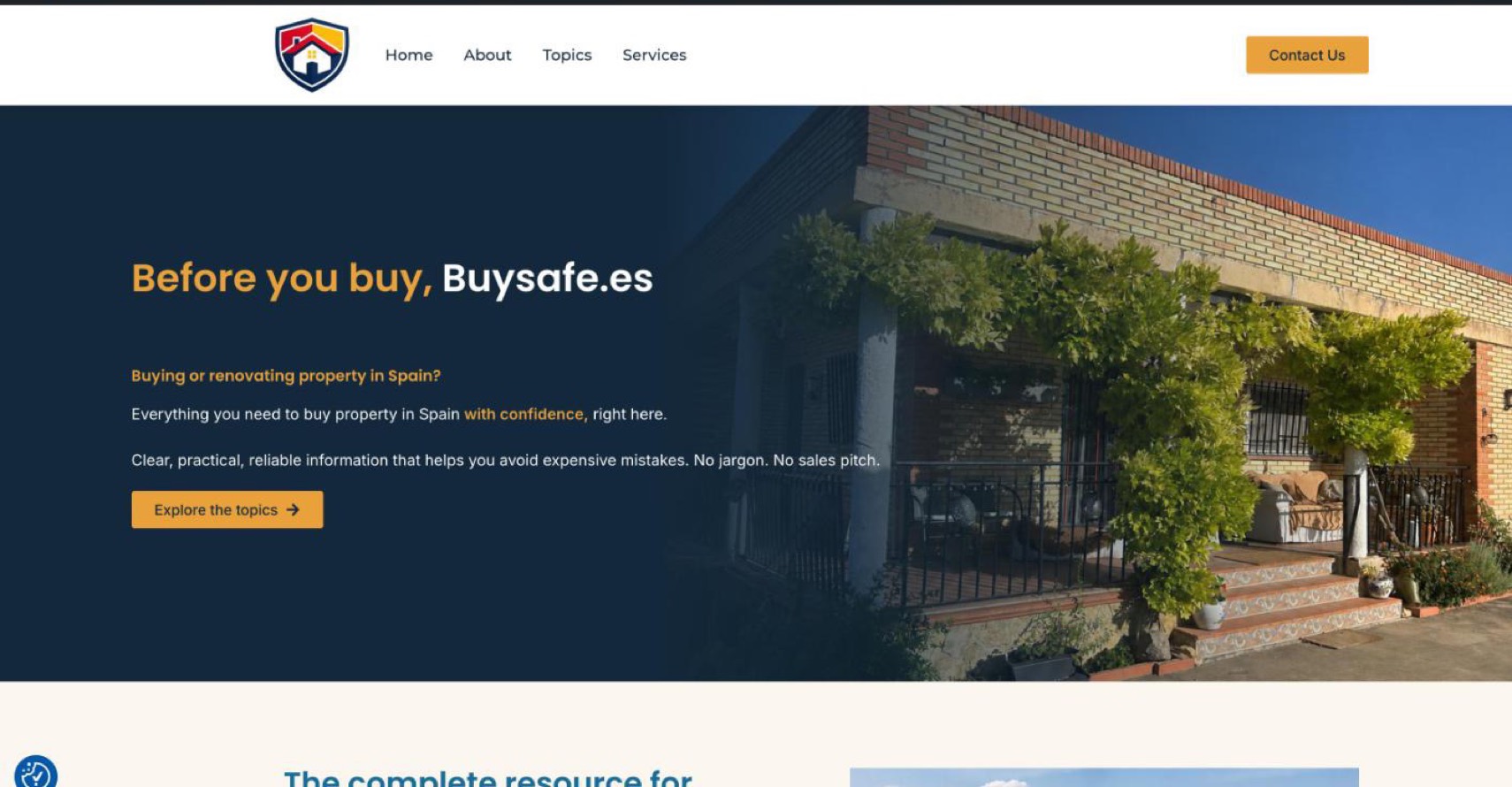
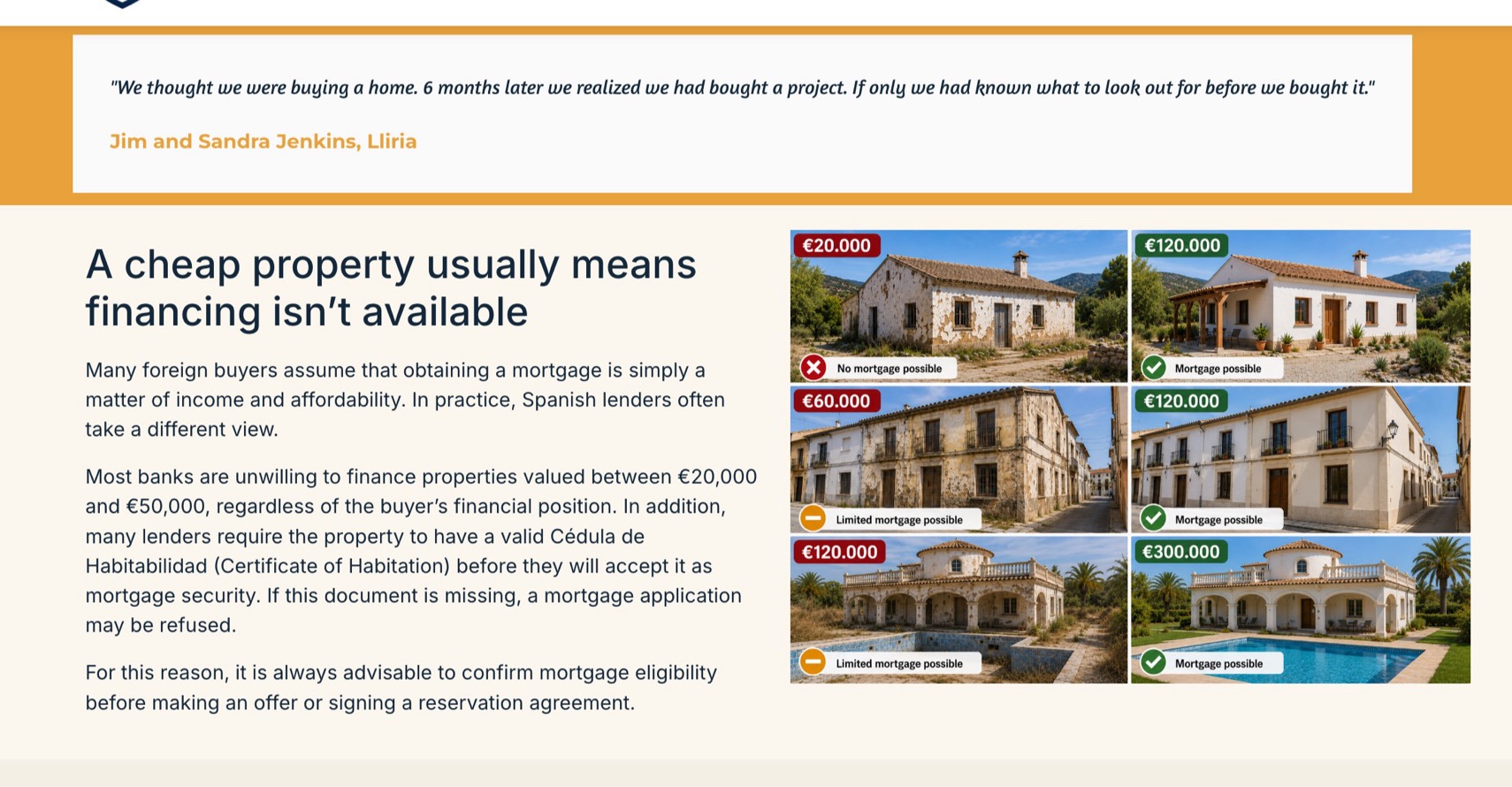
A website that helps British, Dutch and German buyers avoid expensive mistakes when buying property in Spain. I rebuilt it, moved it to a new web address, and set it up to earn money from ads and paid memberships.
Client: Buysafe.es

Project Details
Buysafe.es is a property-advice site for British, Dutch and German expats buying or renovating in Spain. I rebuilt it in Elementor, moved it off its old domain without losing mail or search, and turned it into a monetized platform: display ads, four paid membership tiers, and a payment path proven end to end with a real transaction. The last mile took three months. Google rejected the site for AdSense six times with reasons that were wrong, until the raw server access log showed what was actually happening: its ad crawler had requested the homepage 39 times in four days and been handed a redirect every single time, never once following it. Approved 2 November 2026.
Challenge
- Live on the wrong address. The business was running as veiligkopen.es, a Dutch-only brand, while the English-facing domain it actually wanted sat unused. The move had to carry search, SSL and a Microsoft 365 mailbox across without a gap.
- Revenue depended entirely on plumbing. A membership plugin was installed with no payment gateway, no finished levels and no checkout. An ad plugin was installed but inactive, with no ad code anywhere on the site. None of it was work the owner could do himself.
- A hands-on owner who writes everything. He writes all the content in three languages and builds his own pages. Anything I delivered had to leave him more self-sufficient, not more dependent.
- Nothing could be honestly quoted as one number. The downloads model and the language architecture were both undecided, and AdSense approval was Google's call on Google's timeline, not a deliverable anyone could promise.
Approach
Four phases, priced and gated one at a time
I split the work into four fixed-price phases, each written as its own mini scope document: purpose, what is in, what is explicitly out, acceptance criteria, payment terms. Fifty percent deposit to start a phase, balance on delivery and his approval, and no phase begins until the one before it is accepted. Phases with an undecided variable got a range and the decision that would firm it up, never a firm price on undefined scope. Plugin licences, hosting and payment-provider fees were named as his recurring costs in the quote itself, so the first invoice held no surprises.
Phases 1 and 2 are delivered. The downloads library and the full language switcher are quoted and waiting on his decisions, which is where an owner-run site should sit: nothing bought before it is needed.
The rebuild, and the move
I built the theme in Elementor on a palette he chose from three directions I prepared, with the header, footer and page templates in Theme Builder so every page he builds himself inherits the look automatically. Then the migration: DNS to the host, SSL, the WordPress address switch, and 301 redirects from the old domains, all while leaving the Microsoft 365 mail records untouched so his inbox never moved. Spanish legal pages, cookie consent and a working contact form went up alongside, plus Dutch and German landing pages as a courtesy.
Partway through I found that site email had been failing silently for about two weeks. Microsoft had permanently retired the basic SMTP authentication the site was configured for, so password resets, contact-form mail and member receipts could never have arrived. I rebuilt the path on a dedicated mailbox on his own server and aligned SPF, DKIM and DMARC behind it. Deliverability went from broken to 8.7 out of 10 on mail-tester, with DKIM valid and clean on 23 blocklists.
What Google would not tell us
AdSense rejected the site six times across three months, each time with a label that pointed somewhere unhelpful: "site down or unavailable", "low value content", "replicated content". I treated each verdict as a claim to be disproved rather than a to-do list.
- Reachability, ruled out with Google's own tools. The Rich Results Test crawled the site successfully and 14 external nodes returned 200. A UA-spoofed request from one country proves nothing, so I stopped relying on one.
- "Replicated content", found and fixed. The old domain was still serving a complete copy of the site with the ad code on it. I pointed it at the new domain and cut the sitemap from 26 URLs to the 10 that were real content.
- The actual cause, found in the raw access log. Pulling the Plesk access log and filtering it by Google's IP ranges showed Mediapartners-Google requesting the homepage 39 times over four days and receiving a 301 every time, with zero follow-up requests. The availability checker was stopping at the redirect. Googlebot and Search Console followed the same redirect fine, which is exactly why every outside-in test had looked clean.
- The fix was four lines, not a rebuild. I exempted Google's ad crawlers from the HTTP-to-HTTPS and canonical redirects at the server, left those redirects in force for every real visitor, and verified both paths. The crawler got its first 200 the following day.
The lesson I kept: the server log answers "what did Google actually receive" in minutes, and it outranks any theory built from the outside.
Ads and memberships, with the paying members protected
With approval in hand I turned on Auto ads and set the formats against his brief, deliberately leaving the density controls alone until real ads had landed on real pages. The membership side runs on Paid Memberships Pro with four tiers from a 24-hour pass to lifetime, and PayPal wired as the live gateway.
I then ran a real paid transaction end to end rather than assuming it worked: checkout, membership activated, all eight lifecycle emails sent, then refunded from the admin. That test surfaced two behaviours worth knowing before a customer finds them. A refund does not revoke access, so a refunded member keeps their membership until it is cancelled separately. Abandoned checkouts leave orders behind that look like failed sales but grant nothing.
Hiding ads from members is the part that is easy to get subtly wrong. I keyed it off whether the visitor holds an active membership level, not on whether they are logged in, so an expired or cancelled member starts seeing ads again automatically, which is the product he actually sells. It is verified three ways: logged out, logged in as a member, and against the page cache in both states.
Results
- AdSense approved and serving, after the real cause was isolated in the server log rather than guessed at.
- A working revenue path, proven with real money. Four membership tiers live, PayPal gateway active, one real transaction taken and refunded end to end.
- Members see zero ads, keyed to their membership status and verified logged out, logged in and against the cache.
- The site lives on its own domain with SSL, 301s from the old domains, Spanish legal pages, cookie consent, and email that arrives and authenticates.
- He runs his own content. He writes and ships his own pages on the templates, in three languages, without me in the loop.
- Delivered inside the fixed phase prices, with every scope addition agreed in writing before it cost anything.
Client Feedback
"It was obvious Em knows what she's doing. Her website shows it, and so does the way she communicates and talks about her work. I'd dare to say she's a professional."
Ruud Stuivenberg, Buysafe.es
Tools Used
WordPress, Elementor Pro, Paid Memberships Pro, Google AdSense, Ad Inserter, PayPal, FluentSMTP, LiteSpeed Cache, Plesk, Google Search Console, WPCode



Get Started
Looking to Hire?
I bring 19+ years of cross-functional experience to every role. Connect on LinkedIn to learn more.
Need a Consultant?
Start with a one-hour session on the decision in front of you, or send me the brief for a longer engagement.